Students
Find your campus chapter, meet members at an interest session, and learn what membership involves.
See how to join · Common questions
Improved Order of Patriotic Odd Fellows
Learn with a mentor, lead a campus project, and serve your community. The Collegiate Division brings students and alumni together through four Collegiate Orders built on Friendship, Love, and Truth.
Scholarship • Leadership • Service
Bring the fellowship you built on campus to a new community. The Improved Order of Patriotic Odd Fellows waives the standard setup fee for graduating members who claim their gift within two years. Required new-member fees still apply.
See eligibility and fee detailsFind your campus chapter, meet members at an interest session, and learn what membership involves.
See how to join · Common questionsStay involved through mentoring, chapter service, and collegiate alumni bodies.
Explore alumni membershipReview who can organize a body and where to begin with campus recognition and chartering.
Read charter guidanceCampus chapters give members opportunities to turn scholarship into service. Students can organize tutoring, mentor younger students, plan projects with local partners, and practice leading a team. Alumni can continue that work by advising students and supporting their chapters.
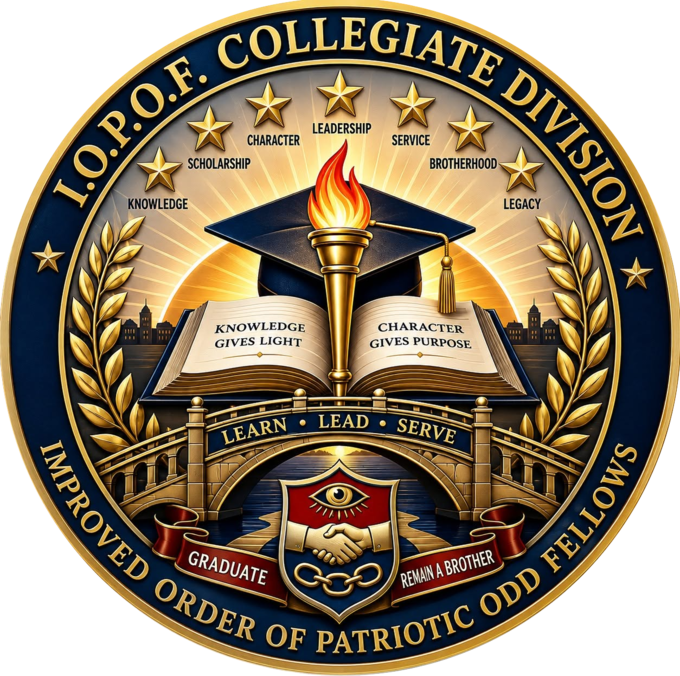
The Collegiate Division carries forward the Odd Fellows tradition of mutual aid and the principles of Friendship, Love, and Truth. The manual traces its South Carolina heritage through District Grand Lodge No. 13 and explains the meaning of the collegiate seal.
Explore what students gain through mentorship, chapter leadership, academic support, and service, and how graduates can continue their fellowship in the wider Order.
Learn the history and principles of the Order, practice chapter leadership, and put that learning to work through service and mentorship.
Read how collegiate chapters fit within the Order, then explore the parent organization’s governance and international structure.
The Collegiate Division manual describes four Collegiate Orders with distinct missions and shared education and service standards.
Ask the I.O.P.O.F. office whether your campus has a chapter or whom to contact about organizing one. Have your college name, city, and state ready.
Start by reviewing the membership journey and eligibility. Ask your campus chapter or the I.O.P.O.F. office about its interest session and application process.
Explore off-campus local-body membership and formation
Only active collegiate members and collegiate alumni members may organize and apply to charter a College Family of Orders body. Ask campus Student Affairs about recognition and contact the I.O.P.O.F. office for charter review.
Start with the Division blog for practical guidance on joining, planning a service project, and staying involved after graduation.
For membership, campus referrals, or charter inquiries, call the parent Order at 843-229-4956.
Parent Order
Improved Order of Patriotic Odd Fellows (I.O.P.O.F.)
Motto
Scholarship • Leadership • Service
The Collegiate Order of the Worthy Torch develops college students into principled leaders through academic excellence, mentorship, career preparation, and community service. Through campus chapters, members support youth, promote physical and mental well-being, expand economic opportunity, and put their education to work through social action.
The Worthy Torch represents knowledge passed from one generation to the next. Each member carries that responsibility by pursuing excellence, mentoring others, and serving their campus and community.
Train student leaders, lead campus and community projects, and organize civic education and advocacy around local needs.
Organize peer tutoring, study groups, and scholarship workshops. Recognize academic achievement and help younger students prepare for college.
Connect students with alumni mentors, host career workshops, and build youth programs that develop confidence, practical skills, and leadership.
Partner with campus and community health organizations to promote wellness, raise awareness, and connect students with support.
Teach financial literacy, support student entrepreneurship, and partner with local organizations on service projects that expand economic opportunity.
Host cultural heritage programs, support exchanges with students from different backgrounds, and explore how local issues connect to global concerns.
Explore member benefits · Explore the annual chapter program
I.O.P.O.F. College Order
The I.O.P.O.F. College Order, known as the Collegiate Order of the Worthy Torch, gives college students a place within the Improved Order of Patriotic Odd Fellows to find mentorship, develop leadership skills, and serve their communities. A student can join a campus chapter, take on responsibilities as they gain experience, and stay connected to the wider Order after graduation.
From your first semester through graduation and beyond, the Collegiate Order of the Worthy Torch helps you build relationships, develop leadership skills, and put what you learn to work in your community.
Fraternal development happens when students practice the values of the Order through real responsibilities. A student might begin by volunteering at a supply drive, later lead the committee that organizes it, and eventually mentor the member who takes over. Along the way, the student learns to plan, listen, follow through, and be accountable to others.
The Order’s principles of Friendship, Love, Truth, Peace, Happiness, Prosperity, Patriotism, and Benevolence guide how members treat one another, carry out their duties, and serve their communities.
Ready to bring the Improved Order of Patriotic Odd Fellows to your community? Explore your two-year graduation gift for opening a new body.
A graduate can stay connected through alumni activities, conferences, service projects, and mentorship. When eligible, the member can also seek membership or participation in an Orchard, Vineyard, or another appropriate I.O.P.O.F. body after graduation or relocation. A former student member can eventually return as a mentor, share internship leads, or help another campus chapter get started.
The College Order’s commitment is to give every student member opportunities to succeed academically, grow personally, lead responsibly, and serve faithfully. A student should be able to look back at graduation and name the people who guided them, the work they led, the community they served, and the relationships they can carry into the next stage of life.
I.O.P.O.F. Collegiate Order of the Worthy Torch Chapter

Read the I.O.P.O.F. Charity & Benevolence Program
Improved Order of Patriotic Odd Fellows
Scholarship • Leadership • Service
The Collegiate Order of the Worthy Torch helps students succeed in college, develop as leaders, prepare for careers, and serve their communities. Each chapter delivers structured programs that benefit its members, other college students, youth, families, and the surrounding community. Chapters schedule their programs around the academic calendar, community needs, and partner availability.
Each chapter should be able to show what its members learned, what they led, and who benefited from their service. Use the recommended chapter performance standards to plan and document those results.
I.O.P.O.F. Collegiate Order of the Worthy Torch
Annual Student Development & Community Impact Program
Scholarship • Leadership • Service
These standards give each chapter a way to show how it advances student success, develops leaders, and serves its campus and surrounding community. Each standard identifies what the chapter should accomplish, who should lead the work, and what records show it was completed.
Deliver at least 12 organized programs annually. Assign a lead and identify the group each program is intended to serve.
Maintain an active mentorship program. Match participating students with mentors and agree on a regular check-in schedule.
Offer academic support each semester through peer tutoring, study groups, or partnerships with campus academic offices.
Hold at least one career development or financial literacy event each semester. Topics may include résumés, interviews, internships, budgeting, or credit.
Record member service hours and maintain working relationships with campus offices and local nonprofits.
Conduct one assessment annually using input from students and community partners. Use the findings to select or improve chapter programs.
Submit one annual impact report summarizing programs delivered, attendance, volunteer hours, people served, funds raised, supplies donated or distributed, and student outcomes.
For each standard, record Met, Partially Met, or Not Yet Met. When a standard falls short, record the gap, the action the chapter will take, and who will follow through.